 Assalamualaikum Wr.WbPuji syukur kehadirat Allah SWT atas karunianya SMP Negeri 7 Bogor dapat menyajikan informasi melalui website sekolah ini.Di era global dan pesatnya teknologi informasi, keberadaa...Read More
Blog Siswa

LIBERTY BELL
The Liberty Bell

Click to enlarge
Tradition tells of a chime that changed the world on July 8, 1776, with the Liberty Bell ringing out from the tower of Independence Hall summoning the citizens of Philadelphia to hear the first public reading of the Declaration of Independence by Colonel John Nixon.
The Pennsylvania Assembly ordered the Bell in 1751 to commemorate the 50-year anniversary of William Penn's 1701 Charter of Privileges, Pennsylvania's original Constitution. It speaks of the rights and freedoms valued by people the world over. Particularly forward thinking were Penn's ideas on religious freedom, his liberal stance on Native American rights, and his inclusion of citizens in enacting laws.
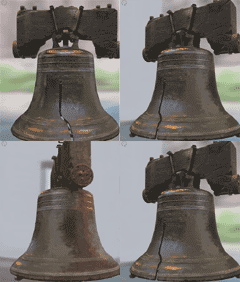
Click to interact with the Virtual Liberty Bell
The Liberty Bell gained iconic importance when abolitionists in their efforts to put an end to slavery throughout America adopted it as a symbol.
As the Bell was created to commemorate the golden anniversary of Penn's Charter, the quotation "Proclaim Liberty throughout all the land unto all the inhabitants thereof," from Leviticus 25:10, was particularly apt. For the line in the Bible immediately preceding "proclaim liberty" is, "And ye shall hallow the fiftieth year." What better way to pay homage to Penn and hallow the 50th year than with a bell proclaiming liberty?
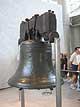
Click to enlarge
Also inscribed on the Bell is the quotation, "By Order of the Assembly of the Province of Pensylvania for the State House in Philada." Note that the spelling of "Pennsylvania" was not at that time universally adopted. In fact, in the original Constitution, the name of the state is also spelled "Pensylvania." If you get a chance to visit the second floor of Independence Hall in Philadelphia, take a moment to look at the original maps on the wall. They, too, have the state name spelled "Pensylvania" (and the Atlantic Ocean called by the name of that day, "The Western Ocean"). The choice of the quotation was made by Quaker Isaac Norris, speaker of the Assembly.
Centered on the front of the Bell are the words, "Pass and Stow / Philada / MDCCLIII." We'll get to Pass and Stow in a bit.
The Crack
There is widespread disagreement about when the first crack appeared on the Bell. Hair-line cracks on bells were bored out to prevent expansion. However, it is agreed that the final expansion of the crack which rendered the Bell unringable was on Washington's Birthday in 1846.
The Philadelphia Public Ledger takes up the story in its February 26, 1846 publication:
"The old Independence Bell rang its last clear note on Monday last in honor of the birthday of Washington and now hangs in the great city steeple irreparably cracked and dumb. It had been cracked before but was set in order of that day by having the edges of the fracture filed so as not to vibrate against each other ... It gave out clear notes and loud, and appeared to be in excellent condition until noon, when it received a sort of compound fracture in a zig-zag direction through one of its sides which put it completely out of tune and left it a mere wreck of what it was."
The Bell as Icon

Click to enlarge
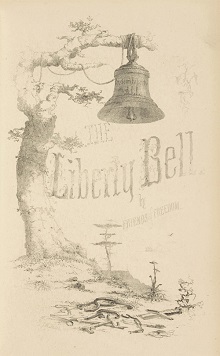
The Liberty Bell. Boston: American Anti-Slavery Society, 1856. Click to enlarge
The Bell achieved its iconic status when abolitionists adopted the Bell as a symbol for the movement. It was first used in this association as a frontispiece to an 1837 edition of Liberty, published by the New York Anti-Slavery Society.
It was, in fact, the abolitionists who gave it the name "Liberty Bell," in reference to its inscription. It was previously called simply the "State House bell."
In retrospect, it is a remarkably apt metaphor for a country literally cracked and freedom fissured for its black inhabitants. The line following "proclaim liberty" is, "It shall be a jubilee unto you; and ye shall return every man unto his possession, and ye shall return every man unto his family." The Abolitionists understood this passage to mean that the Bible demanded all slaves and prisoners be freed every 50 years.
William Lloyd Garrison's anti-slavery publication The Liberator reprinted a Boston abolitionist pamphlet containing a poem about the Bell, entitled, The Liberty Bell, which represents the first documented use of the name, "Liberty Bell."
The Bell and the Declaration of Independence

Click to enlarge
In 1847, George Lippard wrote a fictional story for The Saturday Currier which told of an elderly bellman waiting in the State House steeple for the word that Congress had declared Independence. The story continues that privately he began to doubt Congress's resolve. Suddenly the bellman's grandson, who was eavesdropping on the doors of Congress, yelled to him, "Ring, Grandfather! Ring!"
This story so captured the imagination of people throughout the land that the Liberty Bell was forever associated with the Declaration of Independence.
The truth is that the steeple was in bad condition and historians today highly doubt that the Bell actually rang in 1776. However, its association with the Declaration of Independence was fixed in the collective mythology.
Bell as Symbol
After the divisive Civil War, Americans sought a symbol of unity. The flag became one such symbol, and the Liberty Bell another. To help heal the wounds of the war, the Liberty Bell would travel across the country.
Starting in the 1880s, the Bell traveled to cities throughout the land "proclaiming liberty" and inspiring the cause of freedom. We have prepared a photo essay of its 1915 journey to the Panama-Pacific Exposition in San Francisco.
A replica of the Liberty Bell, forged in 1915, was used to promote women's suffrage. It traveled the country with its clapper chained to its side, silent until women won the right to vote. On September 25, 1920, it was brought to Independence Hall and rung in ceremonies celebrating the ratification of the 19th amendment.
To this day, oppressed groups come to Philadelphia to give voice to their plight, at the Liberty Bell, proclaiming their call for liberty.
History of the Bell

Click to enlarge
On November 1, 1751, a letter was sent to Robert Charles, the Colonial Agent of the Province of Pennsylvania who was working in London. Signed by Isaac Norris, Thomas Leech, and Edward Warner, it represented the desires of the Assembly to purchase a bell for the State House (now Independence Hall) steeple. The bell was ordered from Whitechapel Foundry, with instructions to inscribe on it the passage from Leviticus.
The bell arrived in Philadelphia on September 1, 1752, but was not hung until March 10, 1753, on which day Isaac Norris wrote, "I had the mortification to hear that it was cracked by a stroke of the clapper without any other viollence [sic] as it was hung up to try the sound."
The cause of the break is thought to have been attributable either to flaws in its casting or, as they thought at the time, to its being too brittle.
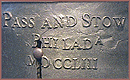
Click to enlarge
Two Philadelphia foundry workers named John Pass and John Stow were given the cracked bell to be melted down and recast. They added an ounce and a half of copper to a pound of the old bell in an attempt to make the new bell less brittle. For their labors they charged slightly over 36 Pounds.

Click to enlarge
The new bell was raised in the belfry on March 29, 1753. "Upon trial, it seems that they have added too much copper. They were so teased with the witticisms of the town that they will very soon make a second essay," wrote Isaac Norris to London agent Robert Charles. Apparently nobody was now pleased with the tone of the bell.
Pass and Stow indeed tried again. They broke up the bell and recast it. On June 11, 1753, the New York Mercury reported, "Last Week was raised and fix'd in the Statehouse Steeple, the new great Bell, cast here by Pass and Stow, weighing 2080 lbs."
In November, Norris wrote to Robert Charles that he was still displeased with the bell and requested that Whitechapel cast a new one.
Upon the arrival of the new bell from England, it was agreed that it sounded no better than the Pass and Stow bell. So the "Liberty Bell" remained where it was in the steeple, and the new Whitechapel bell was placed in the cupola on the State House roof and attached to the clock to sound the hours.
The Liberty Bell was rung to call the Assembly together and to summon people together for special announcements and events. The Liberty Bell tolled frequently. Among the more historically important occasions, it tolled when Benjamin Franklin was sent to England to address Colonial grievances, it tolled when King George III ascended to the throne in 1761, and it tolled to call together the people of Philadelphia to discuss the Sugar Act in 1764 and the Stamp Act in 1765.

Click to enlarge
In 1772 a petition was sent to the Assembly stating that the people in the vicinity of the State House were "incommoded and distressed" by the constant "ringing of the great Bell in the steeple."
But, tradition holds, it continued tolling for the First Continental Congress in 1774, the Battle of Lexington and Concord in 1775 and its most resonant tolling was on July 8, 1776, when it summoned the citizenry for the reading of the Declaration of Independence produced by the Second Continental Congress. However, the steeple was in bad condition and historians today doubt the likelihood of the story.
In October 1777, the British occupied Philadelphia. Weeks earlier all bells, including the Liberty Bell, were removed from the city. It was well understood that, if left, they would likely be melted down and used for cannon. The Liberty Bell was removed from the city and hidden in the floorboards of the Zion Reformed Church in Allentown, Pennsylvania, which you can still visit today.
Throughout the period from 1790 to 1800, when Philadelphia was the nation's capital, uses of the Bell included calling the state legislature into session, summoning voters to hand in their ballots at the State House window, and tolling to commemorate Washington's birthday and celebrate the Fourth of July.
The Bell Today

The Liberty Bell Center was opened in October, 2003. From the southern end, the bell is visible from the street 24 hours a day.
On every Fourth of July, at 2pm Eastern time, children who are descendants of Declaration signers symbolically tap the Liberty Bell 13 times while bells across the nation also ring 13 times in honor of the patriots from the original 13 states. More about this ceremony.
Each year, the bell is gently tapped in honor of Martin Luther King Day. The ceremony began in 1986 at request of Dr. King's widow, Coretta Scott King.
BLOG DICKY SETYADI LAINNYA
Proklamasi Kemerdekaan Indonesia
Proklamasi Kemerdekaan Indonesia Proklamasi Kemerdekaan Indonesia Jumat, 17 Agustus 1945 Tahun Masehi, atau 17 Agustus 2605 menurut tahun Jepang dibacakan oleh Ir. Soekarno yang didampingi oleh Drs. Mohammad Hatta di Jalan Pegangsaan Timur 56, Jakarta Pusat. Pada tanggal 6 Agustus 1945 se...
Read MoreDICKY SETYADI 00:00:00 26-04-2012
Proklamasi Kemerdekaan Indonesia
Proklamasi Kemerdekaan Indonesia Proklamasi Kemerdekaan Indonesia Jumat, 17 Agustus 1945 Tahun Masehi, atau 17 Agustus 2605 menurut tahun Jepang dibacakan oleh Ir. Soekarno yang didampingi oleh Drs. Mohammad Hatta di Jalan Pegangsaan Timur 56, Jakarta Pusat. Pada tanggal 6 Agustus 1945 se...
Read MoreDICKY SETYADI 00:00:00 26-04-2012
tugas ipa pemuaian
Pemuaian Dari Wikipedia bahasa Indonesia, ensiklopedia bebas Pemuaian panas adalah perubahan suatu benda yang bisa menjadi bertambah panjang, lebar, luas, atau berubah volumenya karena terkena panas (kalor). Pemuaian tiap-tiap benda akan berbeda, tergantung pada suhu di sekitar dan koefis...
Read MoreDICKY SETYADI 00:00:00 29-03-2012
tugas mtk
Aljabar Penemu Aljabar adalah Abu Abdullah Muhammad Ibn Musa al-Khwarizmi. Aljabar berasal dari Bahasa Arab "al-jabr" yang berarti "pertemuan", "hubungan" atau "perampungan" adalah cabang matematika yang dapat dicirikan sebagai generalisasi dari bidang ...
Read MoreDICKY SETYADI 00:00:00 29-03-2012
Dendam Dan Munafik
Dendam Dan Munafik Pengertian Dendam Dendam adalah suatu perasaan yang tidak bisa menahan amarah dan menunggu kesempatan untuk dapat melampiaskan kemarahannya itu kepada seseorang yang dianggap telah menimbulkan kemarahannya. Sedangkan pendendam adalah orang yang berkeinginan keras ...
Read MoreDICKY SETYADI 00:00:00 21-03-2012
LIBERTY BELL
The Liberty Bell Click to enlarge Tradition tells of a chime that changed the world on July 8, 1776, with the Liberty Bell ringing out from the tower of Independence Hall summoning the citizens of Philadelphia to hear the first public reading of the Declaration of Independence by Colon...
Read MoreDICKY SETYADI 00:00:00 21-03-2012
aljabar (tugas mtk)
Aljabar Penemu Aljabar adalah Abu Abdullah Muhammad Ibn Musa al-Khwarizmi. Aljabar berasal dari Bahasa Arab "al-jabr" yang berarti "pertemuan", "hubungan" atau "perampungan" adalah cabang matematika yang dapat dicirikan sebagai generalisasi dari bidang ...
Read MoreDICKY SETYADI 00:00:00 07-02-2012
ALJABAR
Aljabar Penemu Aljabar adalah Abu Abdullah Muhammad Ibn Musa al-Khwarizmi. Aljabar berasal dari Bahasa Arab "al-jabr" yang berarti "pertemuan", "hubungan" atau "perampungan" adalah cabang matematika yang dapat dicirikan sebagai generalisasi dari bidang ...
Read MoreDICKY SETYADI 00:00:00 02-02-2012
ARSIP
- November 2021(15)
- Oktober 2021(15)
- November 2020(7)
- Oktober 2020(10)
- September 2020(9)
- Agustus 2020(3)
- Juli 2020(1)
- Juni 2020(2)
- Mei 2020(4)
- April 2020(12)
- Maret 2020(83)
- April 2017(1)
- Januari 2017(1)
- Oktober 2016(1)
- Desember 2015(5)
- November 2015(1)
- Oktober 2015(1)
- September 2015(2)
- Agustus 2015(1)
- Juli 2015(1)
- Mei 2015(1)
- April 2015(1)
- Maret 2015(1)
- Desember 2014(2)
- November 2014(1)
- Oktober 2014(11)
- September 2014(6)
- Agustus 2014(1)
- Juni 2014(2)
- April 2014(2)
- Maret 2014(1)
- Desember 2013(1)
- Oktober 2013(3)
- September 2013(1)
- Juni 2013(1)
- Maret 2013(26)
- Februari 2013(38)
- Januari 2013(8)
- Desember 2012(23)
- November 2012(8)
- Juni 2012(29)
- Mei 2012(17)
- April 2012(248)
- Maret 2012(436)
- Februari 2012(215)
- Januari 2012(486)
- Desember 2011(647)
- November 2011(39)
- Oktober 2011(272)
- September 2011(81)
- Agustus 2011(115)
- Juli 2011(153)
PENULIS
- NUR AZIZAH(430)
- SYAFIRA NUR AMALIA HARYADI(386)
- ISMI SAVIERA ALMIRA(223)
- UMAR FAROOQ ZAFRULLAH(130)
- Naufal Rasyid(107)
- RISA ANJANI(106)
- MOHAMAD ZIDNI RIZKY(63)
- NURUL RIZKY FAKHIRA(60)
- Fauzi Firdaus(47)
- ALI SYAUQI(46)
- ELITA AVIANTI DARMA(43)
- FAUZAN AKMAL HARIZ(41)
- NABILA ISNAENI AMALIA(38)
- RADEN LILOTHA ZATTY AQMAR(29)
- ANDHIKA FIRDAUS(28)
- ADAM RAMADHAN(26)
- RINDANG NOOR ALIFA(25)
- HERI SUHARSO(25)
- RUSMIATI(24)
- ANITA PUJI ASTUTI(18)